Anil Seth - Being You
Notes to chapters 5 and 6

Chapter 5 - The Wizard of Odds
Theme: Perception as Bayesian Inference
Perception = Bayesian process: The brain constantly makes probabilistic guesses (priors) about the causes of its sensory input, and updates them based on the incoming data (likelihood).
Bayesian introduction: A substantial portion of the chapter is devoted to explaining how Bayes' rule works: balancing prior beliefs with new evidence to update beliefs.
Prediction error minimization: Conscious perception arises from minimizing the mismatch between top-down predictions and bottom-up sensory signals.
Precision-weighted prediction errors: The brain doesn’t just try to minimize errors, but weighs them by their expected precision—how reliable the input is.
Attention as precision control: Seth argues that attention = adjusting the precision of prediction errors—it’s not about boosting the signal, but weighting it correctly.
Action-perception cycle: We act to make our predictions come true (e.g., eye movements), closing the loop between action and perception.
Hallucinations explained: Hallucinations may occur when priors dominate and incoming data is underweighted—i.e., when the brain over-trusts its guesses.
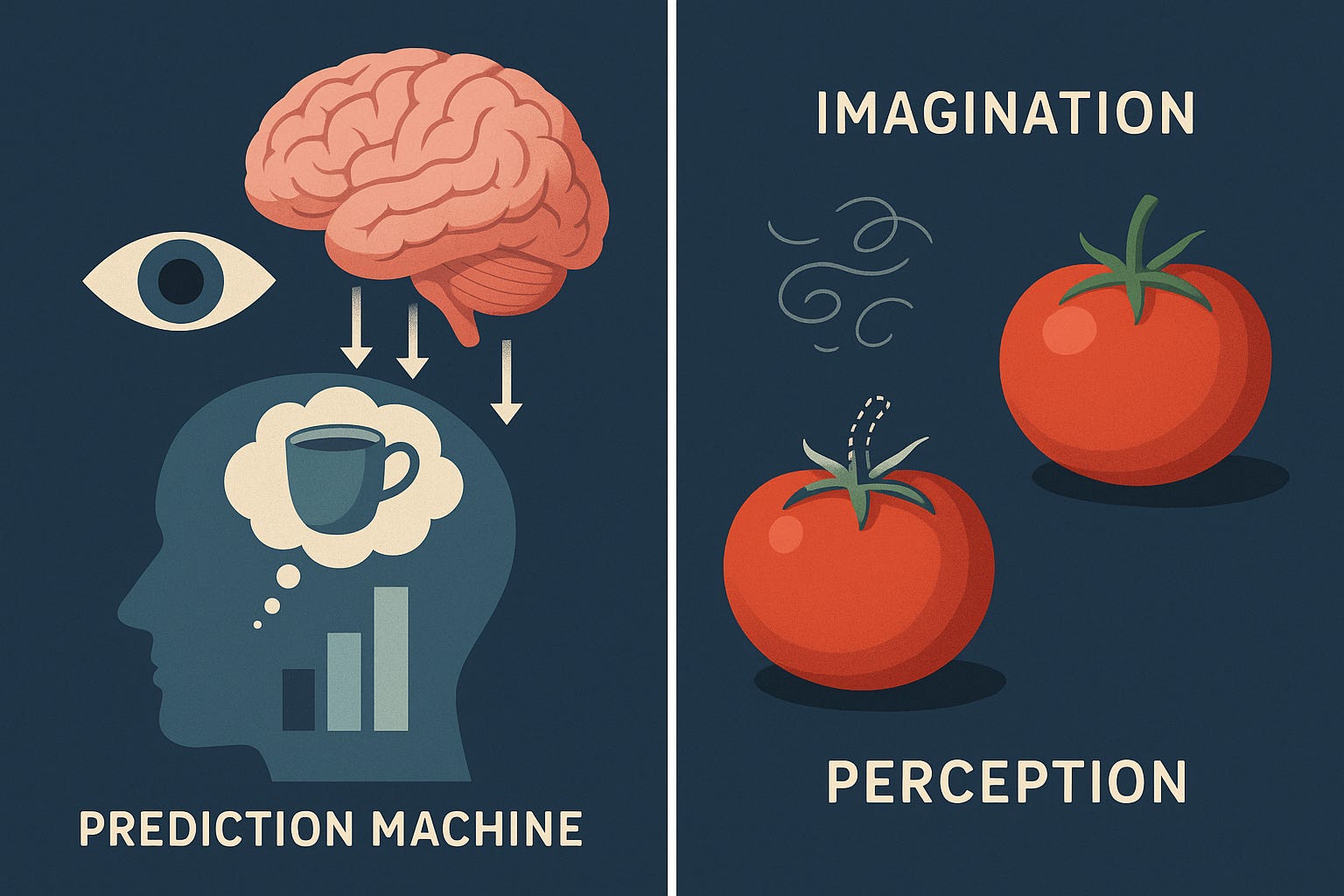
Key metaphor: The brain is not a passive receiver but a “prediction machine”—constantly modeling and correcting, seeking to stay one step ahead.
Chapter 6 - The Beholder’s Share
Main Theme: Perception and reality are co-produced by the brain
Perception is not a mirror: Seth emphasizes that perception is participatory—the brain plays an active role in constructing what is perceived.
“Beholder’s share”: Borrowed from art criticism: the observer contributes to what is experienced, both in art and in general perception.
The brain’s priors come from experience: Priors are not innate or arbitrary—they are shaped by past experiences, culture, biology, and learning.
Perceptual variability: People can have different conscious experiences given the same stimulus due to differing priors.
Deepfakes and perception: Seth uses VR/AR and similar illusions to show how easy it is to fool our predictive systems.
Perceptual presence: A new concept: the feeling that objects are really “there,” even when we’re not currently perceiving all their features.
Explained via sensorimotor contingencies: The brain’s predictions about how perception would change with movement give rise to perceptual presence (e.g., seeing a tomato as round even when part is hidden).
Difference between perception and imagination: Imagination, looking at the blue sky or solar afterimages lack the perceptual presence—the sense that the imagined object would respond to exploration the way real objects do.
Key idea: Perception is structured by predictions of interaction, not just by sensory input; it is inherently action-oriented.