
Bartle and Sherbert - Chapter 3.6
Properly Divergent Sequences

Two roads diverged in a wood, and I -
I took the one less traveled by, and
that has made all the difference

This is a pretty small section, which seeks to fill a small gap in the study of sequences. We’ve mostly been studying under what circumstances sequences converge, and in the process, we were exposed to two or three sequences that could be shown to diverge: (-1)n, sin(n) or n itself. Intuitively, the first two diverge because they are cyclical: their values oscillate perpetually within some bound, which means that no matter what term N(ε) of the sequence you choose, for a small enough boundary around any real number L, there will always be successive terms that lie outside it. In the case of the third, n grows without bound, so no matter what L and whatever you ε-boundary around it you choose, no matter how big, there will be terms of the sequence that lie outside it. It is this latter kind of cases that are studied in this section, and defined as properly divergent sequences, which come in two types:
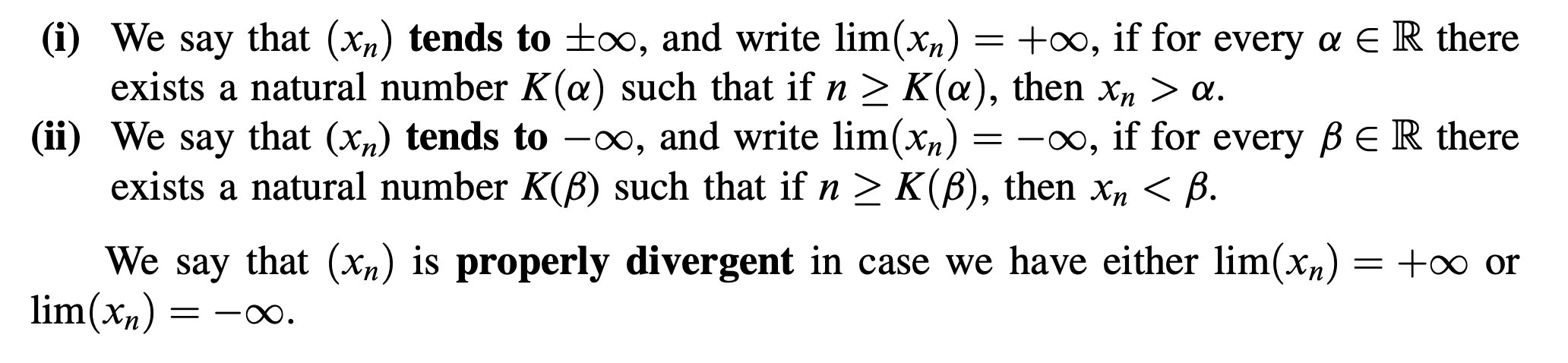
While very useful, the book warns that the limit notation is just a notation: infinity, positive or negative, is not a number, so saying that lim (xn) = ±∞ is just saying the sequence grows (or decreases) without bound, not that it is approximating any real number within any boundaries we can choose. This means a lot of the stuff shown for convergent sequences and their limits does not translate here, in spite of the notation.
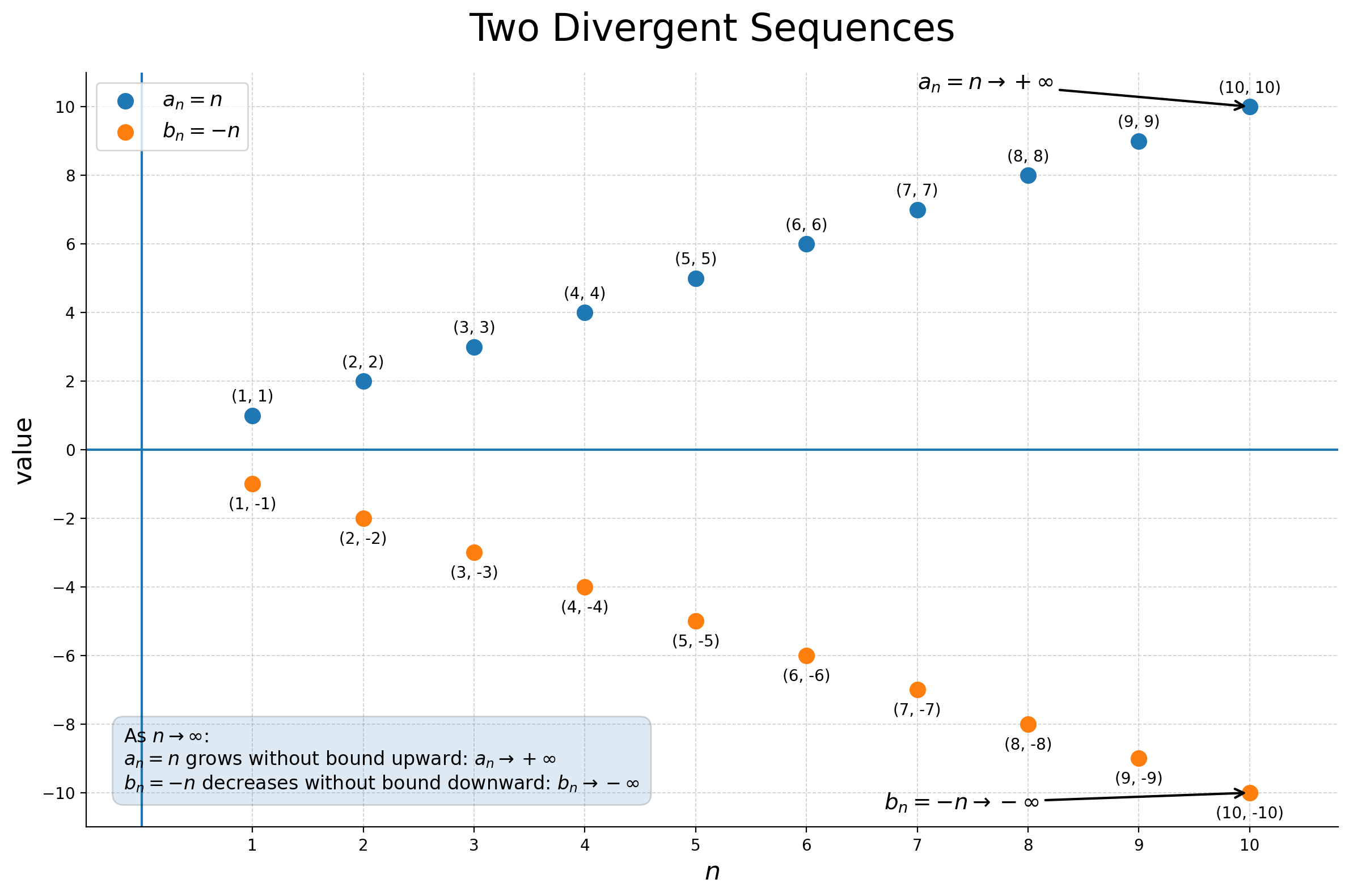
The remainder of the chapter gives some examples and some theorems that can help to show some sequences diverge with relative ease. Monotone sequences, for example, are properly divergent if they are unbounded, so you only have to prove the latter. Given two sequences and the knowledge that one of them diverges, you can use ratios of sequences and/or order relationships between them to determine divergences of the other one.
The exercises were, as usual, a mixed bag. Some where just checking and applying what was taught in the chapter, but a lot of them require some cleverness in combining cases and definitions of convergence, divergence, boundedness and unboundedness so as to prove what you need to prove. I found 1 extremely difficult and confusing because of this. In others, you need to make clever choices for values of α or ε to get all the pieces to come together, as in 4d, 6 or 10. 8d (show that sin √n is divergent) felt extremely difficult and out of my league, as well as unrelated to the other exercises in the section (it an oscillating sequence, and therefore not a properly divergent one) until I got help in spotting the ‘clever trick’ that solves it, i.e., choose the subsequence sin√n2 = sin n and take advantage of the contrapositive of the theorem that if a sequence converges, its subsequences must converge to the same limit, so if a subsequence diverges, than its original sequence cannot converge.
And with this, I am ready to move on to the last section of Chapter 3, which is an introduction to infinite series!