

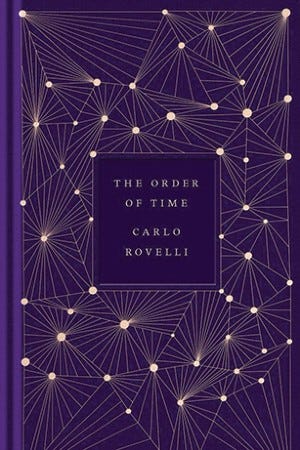
Besides his scientific work, physicist Carlo Rovelli has some 3 or 4 popular science books under his belt. The one we are talking about today is about exactly what you’d expect, given its title: an exploration of the concept of time, mainly through the lens of the great (and counterintuitive) discoveries of 20th century physics.
This is a short book (180 pages of actual reading text), but it packs quite a punch inside it. Starting from the common, everyday and Newtonian concept of time (something that flows uniformly and equally throughout the universe, in the course of which things happen; a flow centered on a really existing ‘now’ and with a clear demarcation of asymmetric past and future), the first part of the volume goes on to demolish this concept with gusto: special and general relativity show us that time is distorted by mass and speed, and ultimately, that time is merged with space to form in spacetime a flexible jelly in which we are immersed and which is not independent of the universe it forms; there is no shared present, but rather partially ordered bubbles or cones, each of them doing their own thing and changing with time; if we move microscopically into the quantum realm, we discover that the equations that rule it and the particles that inhabit it are indifferent to time, with only reversible processes that transform physical quantities from one to another. only entropy seems to provide a way of rescuing some more or less like time at a macroscospic level, in the shape of an arrow pointed towards the increase of disorder; and yet entropy is described by the author as a type of ignorance, a subsuming of different microscopic states that we cannot distinguish at out higher level, and which remain hidden in a Cloud of Unknowing, a fuzziness we cannot penetrate to gaze at the real world that lies behind and beyond it.
The second and third parts of the book are more speculative, including the author’s speculations on how to rebuild our perceived universe of time starting from the world that lacks it. Part of this return is grounded on our perspective and our interactions with this world. We are primed to detect certain variables of the universe instead of others, and among those variables we’ve latched to, and in the subsection of the universe we inhabit, entropy turns to be lower in one direction of our thermal time, giving us a clear way of delineating (a low-entropic) past from (a high entropic) future: “We human beings are an effect of this great history of the increase of entropy, held together by the memory that is enabled by these traces”.
A couple of things about its style warrant mention; firstly, it is clear the author is very used to writing popular science: the book reads wonderfully well, with a hint of literary and philosophical references, and with a content that in spite of its potential pitfalls of technicality, comes through most of the time in a way an educated layman can easily follow. Secondly, while there is some math and physics that rear their (for most readers) frightening heads, most formulas tend to be relegated to the notes, fulfilling that notorious dictum transmitted by Stephen Hawking that one should avoid equations, as each one lowers the readership by about 50%.
Overall, this is a quaint little book that I’ve found both enjoyable and enlightening, and that is all the praise it needs. If you are interested in the topic, you can do no better than make a 3 or 4 day reading gap and devote it your time (pun intended).