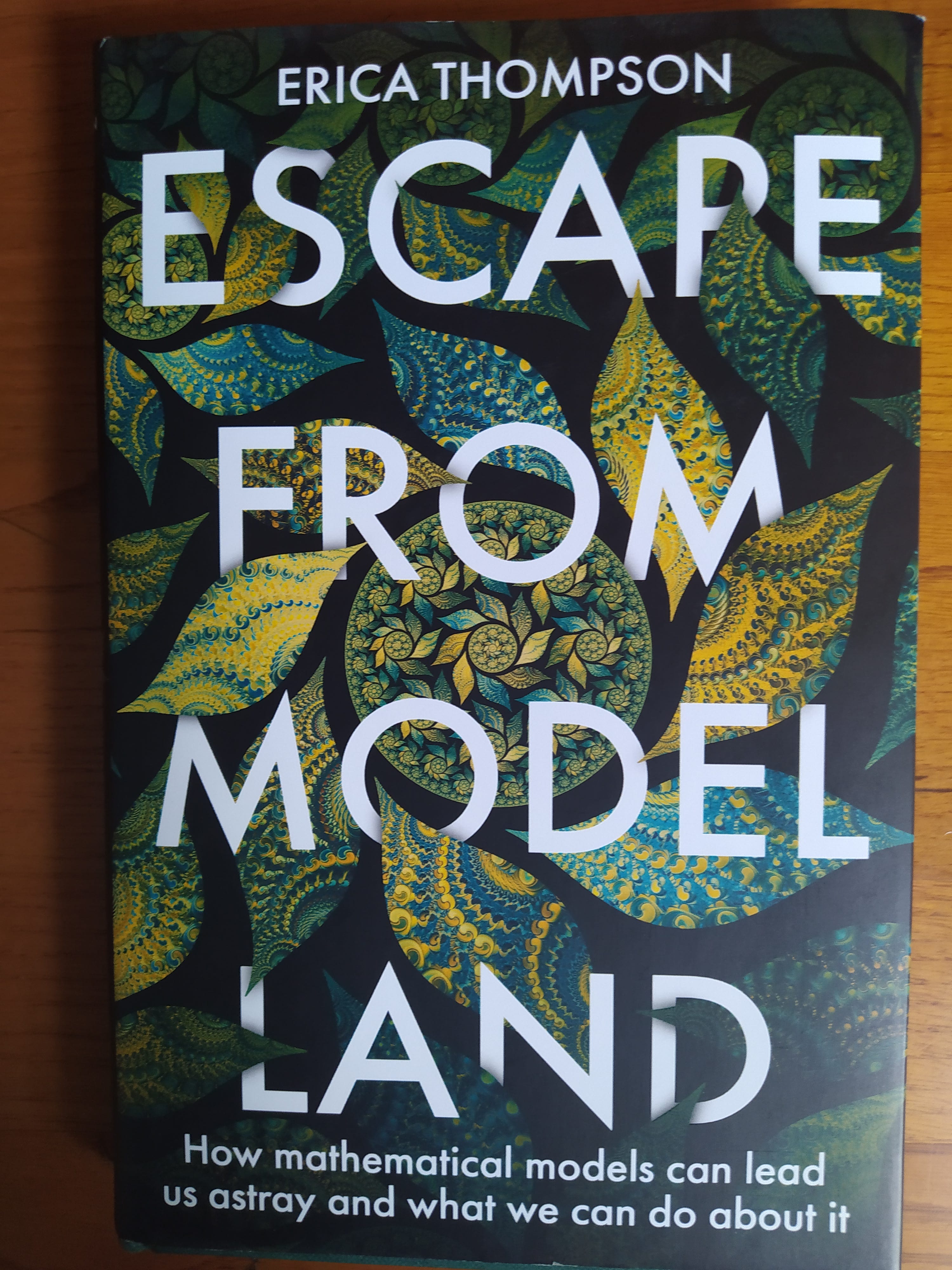
Erica Thompson - Escape from Model Land
Notes to chapters 1 and 2

Chapter 1: Locating Model Land
General Summary:
-The real world is full of data; models are frameworks for interpreting it and the relationships therein, for different pragmatic purposes.
-They range from the conceptual to the heavily quantitative
-Models vary in their detail depending on purpose, and are easier to work and tweak with than reality.
-Nevertheless, that doesn’t mean you can predict everything: One problem are uncertainties, although some of these are quantifiable. But there also exist unquantifiable uncertainties (UU) that we can’t anticipate.
-Key premise of the book: the UUs can and must be taken into account, mainly through the recognition of the limitations that models have.
-A second problem with models is that they bring along ethical, social and political values that determine them.
How shall we avoid these issues?
-We should be more critical of model evaluation (we develop irrational attachments to our hard-built models) and their limits
-We should understand and clearly signal the 2 main ‘‘exits’ from Model Land: 1) in the quantitative, we compare our model with new and outer data; 2) in the qualitative, we make expert judgements about the quality of the modeling (easier said than done), also incorporating outside, ‘real world’ opinion.
There should be a partnership between brain-models and brain-insights. Still, problems that can appear here are subjectivity, cultural bias and ‘pass the parcel’ accountability issues.
Chapter 2: Thinking Inside the Box
General Summary:
-Using a model means severely pruning all the information you consider irrelevant for the key purpose of the model, and thereby negotiating between two extremes: if it is too abstract, it can miss some important aspects of the real world it is modeling; if it is too concrete, it will be impracticable.
-Models come in different types (e.g. the Hydraulic model of the economy, supercomputer weather forecasters). All come with limitations (question omitted, implications, accessibility…), which means there is no ‘perfect’ one.
-A key concept the author dwells upon is adequacy-for-purpose, the difficulties or which will be developed through the rest of the book. We can try to use past success or failure as guides, but sometimes you just don’t have that (climate, economic and epidemiological models), which forces you to rely on a set of subjective, complementary criteria (expertise, ‘real world likeness’, etc…).
-The author also complains that the media tend to extrapolate models improperly (e.g.,from mice to men) and that accountability by experts for model predictions is necessary.
-’All models are wrong, but some are useful’. We should have some humility, whereas some statistical tools tend to act as if models were ‘true’. On the other hand, some make useful predictions. Still, we get questions we can’t just solve with one model or with observation, or where we have contradicting models (and there is only one physical reality).
-The author ends the chapter with a call for a plurality of models in practice as a way to try to tackle biases, aporias and limitations of each of the individual ones.