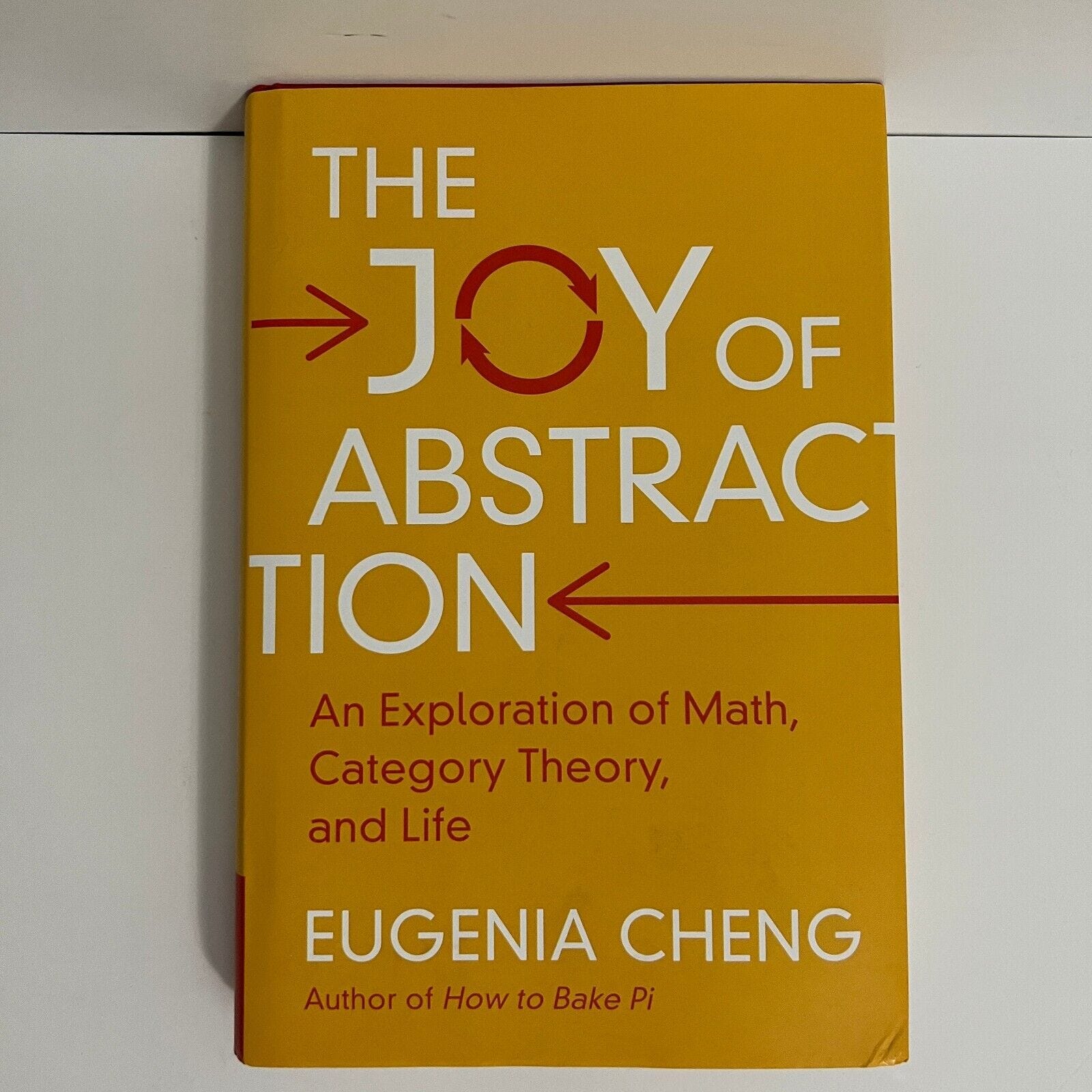
Eugenia Cheng - The Joy of Abstraction
Notes to Prologue and chapter 1

Prologue
General Summary: The prologue outlines the contents of the book, the reasons for reading and writing it, and the intended audience(s). Its first thesis is that abstract math is a joy, enlightening and useful, and contrasts it with the type of math you might have been taught (and learned to hate) at school. It insists that abstract math does not require the concrete, school one as a prerequisite, and in fact, presents this book as such a foray into Category Theory. It explains that the book bridges the gap between the undergraduate textbooks and a lay audience, and that it is quite wordy, slow-paced and subjective-personal to make access easy, but will require some effort from the readers.
Details:
-The importance of math, but taking it beyond the usual examples
-The ‘hurdles’ model of teaching math, and the value of being a mathematical tourist
-A very wide intended audience.
Chapter 1
General Summary: The author states that Category Theory is the ‘math of math’, but this doesn’t mean it has to be accessed either through an undergraduate math background or through a historical approach. The chapter explains in a light way the key concepts of Category theory which will be detailed and fleshed out in the remainder of the book, so it acts as an introductory summary of sorts.
Details:
-Abstractness: CT uses abstraction to focus on details required in a specific situation, and to think and derive rigorously, in a way that is not possible if you are tied to the very concrete.
-Connections: CT strives to find connections and patterns between areas that are superficially different. Abstractness makes this easier.
-Context and Relationships: CT focuses on defining contexts by the relationships that take place within, instead of by ‘essential’ properties of objects. Same objects with different relations create a different context. Sometimes, our choice is contingent.
-Sameness: there are different types of this that can be explored rigorously, beyond ‘equality’.
-Zooming: CT navigates between different contexts and also in and out, meta referential. It also adds nuance and subtlety that can be exported to everyday life.
-Techniques: Finally, CT is a rigorous area of math, so comes with techniques and framework, which will be gently introduced in the latter part of the book.