
Mapping the Unmappable
Spatial Turn, Postmodern City, Cybercity (part 2)

2. “No Maps for These Territories1”: Literary, Theoretical and Urban Cartographies
The map metaphor, as we said, comes to occupy a transcendental position. These are, however, maps read and framed within a logic of decentering, tied to the burning wheel of Ixion, repeatedly dragging the Sisyphean stone of attempting to map the unmappable: a reality that has abandoned, whether out of naïveté or impossibility, the hope of totalization (including, evidently, that of these very maps). Thus—according to Cavallaro:
Maps are metaphors, figures, or tropes, and therefore should not be confused with literal reality […]. Maps are deconstructive texts (that is, self-dismantling ones). They are abstract constructs based on the selection of details belonging to a contingent geographical situation2.
A very similar model of such maps is presented by Deleuze and Guattari in “Rhizome,” the introduction to A Thousand Plateaus:
The map is open, connectable in all its dimensions, detachable, reversible, susceptible to constant modification. It can be torn, altered, adapted to various assemblies, initiated by an individual, a group, a social formation. It can be drawn on a wall, conceived as a work of art, constructed as a political action or as a meditation3.
Many studies of the postmodern city revolve around the chaotic construction/destruction of “total” maps and urban scenarios that continually re-inscribe and de-inscribe themselves. In this respect, it is significant that the images of Jorge Luis Borges serve as a frontispiece both to the famous opening of Jean Baudrillard’s Simulacra and Simulation and to a crucial chapter of Edward Soja’s Postmodern Geographies: in the former, the appropriation/subversion of the fable of the empire covered by its map—"slowly falling apart into ruins, some still visible in the deserts4"—serves as a point of departure, an anti-image of the new Simulacrum. “Even inverted,” says Baudrillard, “Borges’ fable is unusable. Perhaps only the allegory of the Empire persists. For it is with the same imperialism that today’s simulators attempt to make the real, all of the real, coincide with their models of simulation5.”
In Soja’s case, the image is Borges’ Aleph—the all-unified-in-space so elusive and resistant to the sequential logic of discourse—that is inflated to metaphorize the subject of his study: Los Angeles.
Los Angeles, like Borges’ Aleph, is extremely difficult to track, particularly resistant to conventional description. It is hard to persuasively capture in a temporal narrative, as it generates too many conflicting images, disrupting historicization, always seeming to expand laterally rather than sequentially. At the same time, its spatiality challenges orthodox interpretation and analysis, as it seems boundless and constantly in motion6.
But here the two authors, consonant with their different projects, diverge, sharing only the chosen space of Los Angeles as a paradigm of the Postmodern City. In Taking Los Angeles Apart, Soja offers—despite his alternative proposals—a rather traditional reading (a scientific-descriptive one, if you will, and clearly an heir to Marxism and Critical Theory) in which the unmappable becomes the object of a mapping attempt. The study of the different spaces reveals past and present: the military-industrial complex which forms a sixty-mile circumference around LA is presented as one of the reified realities of a city that exhibits the spectacle of the simulacrum (Hollywood) and computer technology while concealing its recovery from industrial crisis (the modernist moment, anchored in a geography of impoverished, rusted neighborhoods) through an accelerated military Keynesianism (ironically, the "Warfare Estate"). Panoptic images—which bring to mind Foucault and a model that, nevertheless, poorly fits7 the decentered and postindustrial city—emerge in the downtown, the political and control nucleus, flanked by the high towers of transnational capitalism:
This panoramic vision contains the clustered castles and cathedrals of corporate power, the bright new ‘central business district’ neighboring its aging predecessor just to the east. Here too the endless eyes of the LA-leph remain open and reflective, looking outward and mirroring global spheres of influence, placing the world just within reach8.
It’s a world characterized by deconstruction of the center, atomization and compartmentalization into gated neighborhoods by ethnicity, means, status, and life projects; of concealment of labor—that cheap, multinational workforce that only surfaces in the picturesque façade of ethnic districts—within the frame of a Disneyfied city with invisible inspectors despite the appearances of freedom of choice. Soja states:
Beneath the semiotic blanket persists the economic order, an instrumental nodal structure, a spatial division of labor that is essentially exploitative, and this spatially organized urban system has, over the past half-century, been more continuously productive than almost any other in the world. But it has also been progressively reified, hidden in plain sight, in an environment more specialized in producing all-encompassing mystifications than perhaps anywhere else […]. When all that is seen is so fragmentary, so full of whimsy and pastiche that the hard edges of the capitalist, racist, patriarchal landscape seem to vanish into thin air9.
As might be expected, a completely different approach to the same subject is the focus of Jean Baudrillard’s extremely whimsical book America10. Through a series of photographs and short fragments in the theoretical-poetic style the author is best known for, the continent and the city in question emerge in small, disconnected flashes—in rich, electronic descriptions reminiscent of science fiction literature:
There is no equivalent to flying over Los Angeles at night. A kind of luminous, geometric, incandescent immensity, stretching as far as the eye can see, exploding in every fold of the clouds. Only Hieronymus Bosch’s hell can rival this infernal effect. The mutated fluorescence of all the diagonals: Wilshire, Lincoln, Sunset, Santa Monica […]. At night, this city condenses all the future geometry of human relational networks—brilliant in their abstraction, luminous in their extent, astral in their reproduction of the infinite. Mulholland Drive at night is the privileged viewpoint of the extraterrestrial over the Earth—or, inversely, the privileged viewpoint of the human when contemplating the galactic metropolis11.
There’s a passion for images that rhymes, theoretically, with the visions of Richard Lehan, who, writing precisely from that sidereal Los Angeles, adds:
Once the city becomes a system of signs, we need the transcendental signifier (whether God, nature, history, or the rational mind) to keep the other signs in place […]. Without a transcendental signifier, urban signs begin to float, and meaning gives way to mystery. Seen from within a system as unstable as Derrida’s system of language, the city loses its claim to being ‘real12.’
Emphasizing the dystopian aspects of postmodern Los Angeles, we also have City of Quartz by Mike Davis13, whose readings of the city often reference the film Blade Runner and a future that LA seems to consciously aspire to; as in Soja’s studies, we see a city turned into a high-security state, a space of control and containment, and the “fortress effect” appears not as a design flaw but as a deliberate socio-spatial, strategic feature.
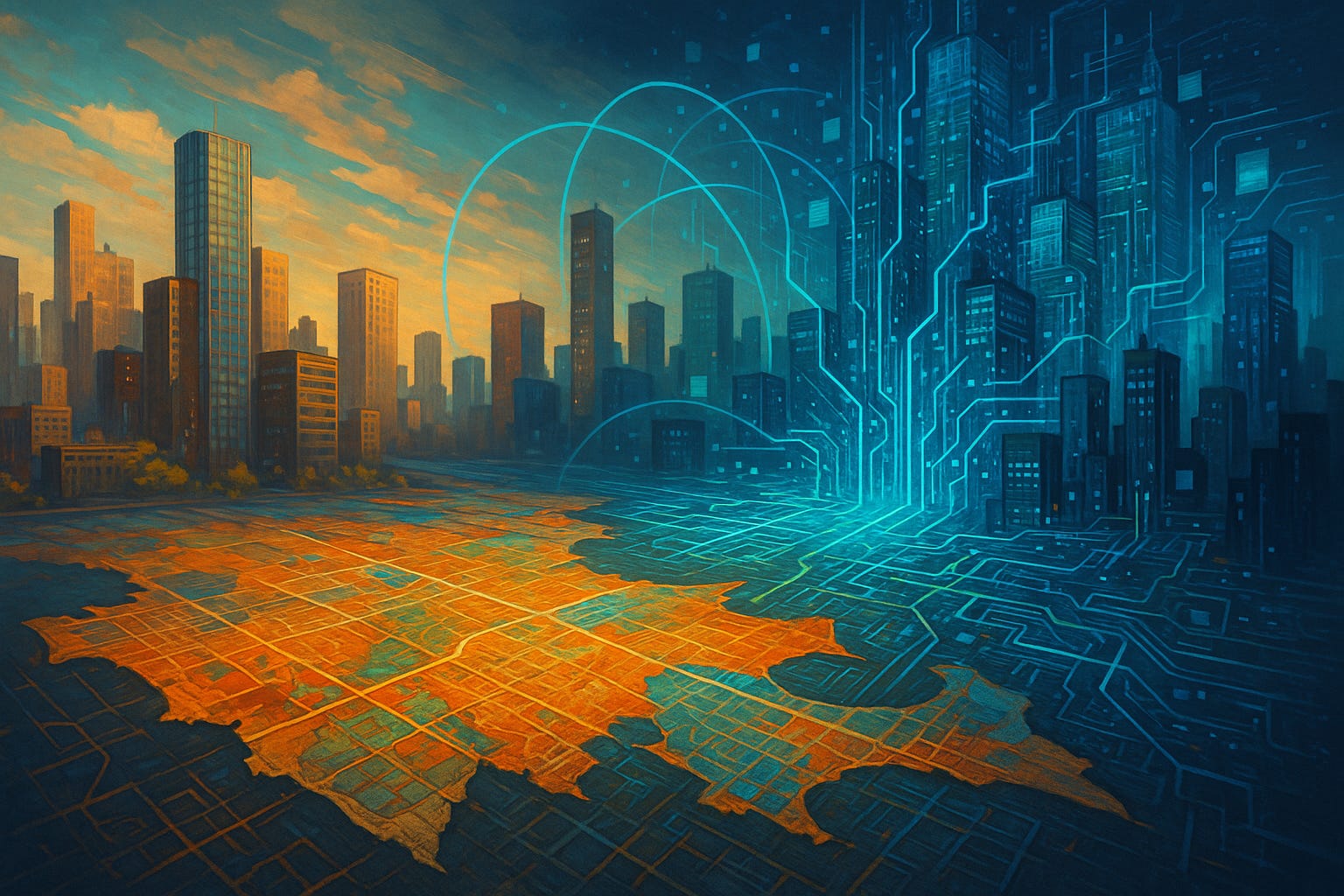
The emphasis on the loss of reality, and Davis’s book itself (not coincidentally prefaced with a quote from William Gibson, suggesting Davis’s work is more cyberpunk than his own), serve as a bridge for the transition to the Cybercity and its literary antecedents, centered on the cyberpunk genre of contemporary science fiction, and emblematically, in Gibson’s novel Neuromancer14. In its dystopian depictions of an artificial and decaying urbanized society, of a decentered spatiality under the control of large transnational corporations, but at the same time highly technologized (especially in cybernetics, biotechnology, and information technologies), the landscapes of the postindustrial city merge with the metaphorical development of virtual and networked worlds—of the “electronic city,” Cyberspace, Metaverse, the Matrix, the Wired:
Whether it is what Baudrillard calls telematic culture, or what science fiction writers describe as the Web, the Grid, the Matrix, or more successfully, Cyberspace, there is a widespread acknowledgment that a new and decentered spatiality has emerged—one that exists in parallel with, but outside of, the geographic topography of experiential reality15.
The specter of virtual cities haunts the pages of cyberpunk fiction16 precisely a few years ahead of the mass development of all the very real mechanisms and new technologies that have made cyberspace possible. The postmodern city is reconceptualized to include within itself information networks and their incredible speeds of transit and exchange, metaphors of electronic and disembodied states, the flux of interchangeable images that defy fixed limits. “Cities,” says Manuel Castells, “are simultaneously structured and destructured by the competing logics of the space of flows and the space of places. Cities do not disappear into virtual networks. But they are transformed by the interface between electronic communication and physical interaction, by the combination of networks and places17.”
Both types of space (the virtual and the urban) appear as imploded, amorphous, without boundaries. The inward focus (prefigured by developments in chaos theory and fractals) is accompanied by a desire for ‘physical’ exploration of electronic spaces, for which the postmodern city serves as the blueprint, and science fiction—long accustomed to the task of mapping unusual spaces— as a guide. At the same time, the physical-electronic juxtaposition gives rise to a necessary reconceptualization of these spaces:
In a world of ubiquitous telecommunication and computing, electronically enhanced bodies, post-Infobahn architecture, and big-bit business, the very idea of the city is called into question and must eventually be reimagined. Computer networks become as fundamental to urban life as the street grid. Screen space and memory become a kind of valuable and sought-after real estate. A great deal of cultural, political, social, and economic action is reoriented toward cyberspace18.
Several conceptual tools prove useful for studying these peculiarly new loci. As “other spaces,” we cannot ignore Michel Foucault’s heterotopias19. This category effectively evokes the dangers of the Electricity Fairy’s realms and of the labyrinthine architectures of the postindustrial city in reflections that emphasize the hidden strategies of exclusion these two places conceal (“everyone can enter heterotopic sites, but in truth, this is only an illusion: they believe they’re entering, but by that very act, they are excluded”) and their mirror-like qualities, which reflect the economic and social conditions of late capitalism; as Foucault explains:
They function in relation to all the remaining space. This function unfolds between two extreme poles. Either their role is to create a space of illusion that exposes as even more illusory all real space […], or, on the contrary, they create another space, another real space as perfect, as meticulous, as well-arranged as ours is disorganized, poorly managed, and muddled.
A complementary tool we also consider relevant here is the concept of paraspace, coined initially by science fiction writer Samuel Delany to refer to a series of mental spaces in that genre’s literature which exist parallel to the diegesis—rhetorically marked “other spaces20.” These paraspaces contrast in the novels with other “normal” spaces (those of a recognizable future) as alternative, usually mental (though materially manifested) spaces, coexistent with normal space, ones in which language rises to an extraordinarily lyrical level and in which the plot and contradictions from the main space are often resolved. Critic Scott Bukatman has made a clever extrapolation of the concept as a more abstract hermeneutic tool valid for other media (in cinema, for example, the paradigmatic moment of paraspatiality is found in the psychedelic “trip scene” in Kubrick’s 2001, but also in the use of special effects) and spheres: thus, the genre of science fiction itself would function as paraspace relative to mainstream literature, quantum physics would recreate a peculiar paraspace at the subatomic level, and (for our purposes) the postmodern city becomes the Zone—an other space of ontological displacement and collision, a peculiar paraspace governed by the absence of coordinates and borders, paradoxical in its lack of depth, a creator of a non-space, a non-place where, quoting Hassan i Sabbah, the hashashin master from Burroughs’ fiction, nothing is true, everything is permitted:
The Zone is usually the place where ontological shifts take place in these diegeses. In Tarkovsky’s Stalker, the mysterious alien-visited zone is named the Zone, just as the fragmented Germany that Tyrone Slothrop travels through in Pynchon’s Gravity’s Rainbow is. In William Burroughs’ spatial mythology, the region where everything is allowed and everything coexists was the Interzone. The city/cosmos of Alphaville is divided into zones21.
But these boundaries between normal space and paraspace are porous and do not remain closed. On the contrary, their flexibility enables the creation of hybrid and heterogeneous sets that allow, in a kind of inverted logic, the analysis (and mapping) of the unmappable. Focusing on Gibson and electronic/urban spaces, Bukatman clarifies:
By mapping cyberspace right atop this entropic urbanism and this slippery subjectivity, Gibson erases the boundary between normal space and paraspace—a sleight-of-hand move with important consequences. The neon spaces of Neuromancer, explained in science fiction terms as a “consensual hallucination” of “infinite data space,” allude to the shifting opalescences of postmodern representation, while the distance produced by this allusion allows the text to resist the comforting security of the predictable unpredictabilities of postmodernism22.

This was the title of a 2000 documentary by Mark Neale about the famous science fiction writer William Gibson.
Cavallaro (2000), 134.
Deleuze/Guattari (1988), 12.
Borges (1987), 144.
Baudrillard (1994), 1.
Soja (1989), 222.
We consider this ‘poor fit’ as we find more persuasive Gilles Deleuze’s argument that the panoptic, or disciplinary, model of social control has been replaced by a different one (the control model), in which new technologies enable new forms of repression through extensive networks of electronic control and surveillance. In this sense, the breakdown (or at least, the crisis) of disciplinary and closed spaces does not open the door to freedom, but merely introduces a new form of domination, “with ‘digital subjects’ who can be investigated, controlled, tracked, and commodified, subjects who, in a certain way, police themselves through their participation in the extensive networks of endless electronic links that always leave behind digital traces”; Deleuze (2004), 73.
Soja (1989), 223.
Soja (1989), 246.
See Baudrillard (1989). It is, however, noteworthy that the author does not avoid an expected aesthetic reading/interpretation of the Bonaventure Hotel (also presented as an example by Soja), which has become (since F. Jameson’s classic reference) the archetypal embodiment of postmodernity, “the (post-modern) universe in a nutshell,” if we may use the image: “Structures like the Bonaventure Hotel aim to be perfect and self-sufficient miniature cities. But they cut themselves off from the city more than they interact with it. They cease to see it. They reflect/reject it, like a dark surface. And you cannot exit the building itself. Nor can you measure its internal space, yet it is entirely devoid of mystery”; Baudrillard (1989), 60.
Baudrillard (1989), 51-52.
Lehan (1998), 265.
Davis (2006).
Gibson (1984).
Bukatman (1993), 105.
Not only cyberpunk, though it may be its most privileged space. One of its New Wave forerunners, the African American science fiction writer Samuel R. Delany, described the virtual city in his 1984 novel Stars in My Pocket Like Grains of Sand (the same year Neuromancer was published) in the following terms: “In a certain way, urban complexes soon transform into an intensified display of the products generated by the geosector around them, so that a free data transfer point becomes a kind of partial city against the backdrop of night, the image of a city without the substance of a city, gaining what solidity it possesses from the infinite cross-linked networks of data.” (Delany, 2004, p. 69)
Castells (2004), 85.
Mitchell (1997), 107.
See Foucault (1984) for the next two quotes.
Delany (1988).
Bukatman (1993), 163.
Bukatman (1993), 170-171.